The Best Schools in Toronto in 2026, and How Families Actually Get In
Every family wants the same thing: the best school for their kids. In Toronto, the answer is rarely just about the building. It is about the boundary around it, the price of the homes inside that boundary, and a few access routes most parents never learn about.
I see it every week. Two nearly identical homes, a few blocks apart, and one sells for noticeably more. The difference is almost never the kitchen. It is the school zone.
This guide does three things. It names the strongest school neighbourhoods in the city. It shows you how those schools move home prices. And it walks you through how families actually secure a seat, including the Out of Area route that most parents miss and the public versus private math that quietly decides a lot of these moves.
Why the Best Schools in Toronto Drive Home Prices
When you buy a home with school age kids, you are not just buying a property. You are buying a guaranteed seat at a specific school. The Toronto District School Board (TDSB) assigns every address to a catchment, and that assignment travels with the home.
When a school performs well, demand for real estate inside its boundary rises. When a school runs JK through Grade 8 under one roof, something I call catchment locking kicks in. Families move in for kindergarten and have no reason to move again for a decade. No middle school transition, no second move. That keeps inventory tight inside the boundary and supports prices over the long term.
Swansea Junior and Senior Public School and Runnymede Junior and Senior Public School are textbook examples. Both run JK to Grade 8, both sit in established West End pockets, and both anchor some of the most stable family housing in the city.
How to Read the Rankings Without Getting Burned
The Fraser Institute publishes annual rankings out of 10 based on provincial EQAO testing. Parents love them because they are simple. That simplicity is also the trap.
Here is what I tell every client.
Small schools swing. A school with two kindergarten classes can jump or drop a full point on one cohort. A 7.9 this year and a 9.1 last year is not a school in decline. It is statistics.
The average across five years matters more than this year's number. Whitney Junior Public School in Moore Park holds an average near 9.6 across the last five years. Rosedale area schools sit around 9.0. That consistency is what supports property values, not a single hot year.
No rating does not mean a weak school. Maurice Cody in Davisville currently shows no Fraser rating, yet its EQAO results are excellent. Some of the best schools in the city are unranked in a given year.
The Best School Neighbourhoods in Toronto
Swansea and Bloor West Village
The classic Toronto family corridor. Tree lined streets, High Park at your doorstep, and a cluster of strong JK to 8 schools that keep families rooted.
| School | Grades | Fraser Range | Worth Knowing |
|---|---|---|---|
| Runnymede Jr & Sr PS | JK to 8 | 8.2 to 9.4 | Dual track with French Immersion from JK |
| Swansea Jr & Sr PS | JK to 8 | 8.1 to 8.6 | Triple track including Extended French |
| Howard Jr PS | JK to 6 | 8.4 | Quiet Roncesvalles street, strong French Immersion |
| Humbercrest PS | JK to 8 | 7.7 to 8.3 | STEM focus, serves the Jane and Annette pocket |
| Keele Street PS | JK to 8 | 6.6 to 7.2 | Diverse community school sharing a pool |
The takeaway: homes inside the Runnymede and Swansea boundaries carry a real premium, and the JK to 8 structure means they rarely come up for sale.
Riverdale and Leslieville
The East End school culture leans progressive. EcoSchool certifications, teaching gardens, arts integration. It matches the neighbourhood perfectly.
| School | Grades | Fraser Range | Worth Knowing |
|---|---|---|---|
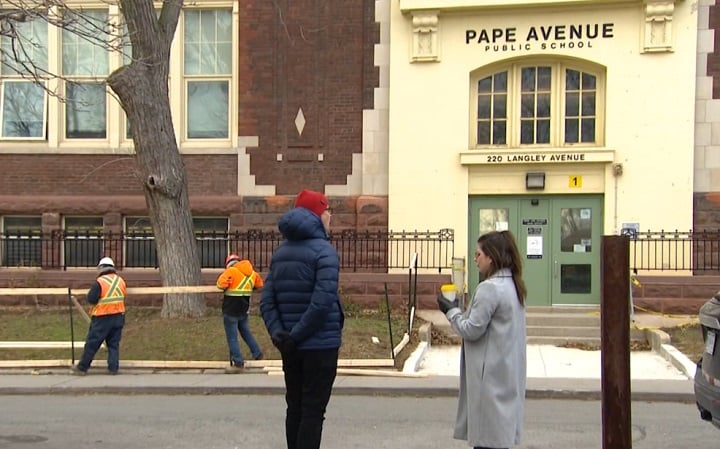
| Pape Avenue Jr PS | JK to 6 | 8.6 to 9.7 | Temporarily relocated during Ontario Line construction |
| Withrow Avenue Jr PS | JK to 6 | 8.5 | Platinum EcoSchool with an organic teaching garden |
| Jackman Avenue Jr PS | JK to 6 | 7.9 | Playter Estates, very active parent council |
| Frankland Community School | JK to 6 | 7.7 | Heart of Riverdale on Logan Avenue |
| Morse Street Jr PS | JK to 6 | 5.9 | Leslieville, strong arts integration |
One thing buyers should know. Pape Avenue's relocation during subway construction changes the morning commute even though the legal catchment has not moved. The boundary value is intact. The convenience is temporarily impacted.
Midtown: Leaside, Davisville, Lawrence Park, Moore Park
The most concentrated cluster of academic performance in the city, and real estate prices reflect it.
| School | Grades | Fraser Range | Worth Knowing |
|---|---|---|---|
| Cottingham Jr PS | JK to 6 | 10.0 | A perfect score, boutique school near Summerhill |
| Whitney Jr PS | JK to 6 | 9.2 to 9.7 | Moore Park, average near 9.6 across five years |
| John Ross Robertson Jr PS | JK to 6 | 9.3 | Lawrence Park, Middle French Immersion from Grade 4 |
| Allenby Jr PS | JK to 6 | 9.0 | Established in 1931, deep prestige |
| Bessborough Drive E & MS | JK to 8 | 7.3 to 9.9 | Leaside hub, recently near perfect |
One caution. Several Midtown school buildings predate the war and are not physically accessible. Bessborough lacks elevators. Northlea is the standout for full accessibility.
Downtown and the Downtown West End
Here the dynamic flips. Condo development has outpaced school capacity, and the TDSB posts capacity warnings on many new towers, meaning your child could be redirected to a school outside the neighbourhood.
That is exactly why low rise homes inside strong downtown catchments are so fiercely contested.
| School | Grades | Fraser Range | Worth Knowing |
|---|---|---|---|
| Ossington Old Orchard Jr PS | JK to 6 | 9.5 to 9.7 | Exceptional rankings driving fierce demand |
| Montrose PS | JK to 6 | 9.3 | Little Italy, Japanese International Language program |
| Lord Lansdowne Jr PS | JK to 6 | 9.1 | South Annex, French Immersion Centre only |
| Clinton Street Jr PS | JK to 6 | 9.0 | Specialized Gifted stream for Grades 4 to 6 |
| Palmerston Avenue Jr PS | JK to 6 | 8.5 | Seaton Village, dual track |
Buyer notes. If you are buying a condo downtown, check for a TDSB capacity warning before you sign. And Lord Lansdowne is French Immersion only, so English stream children are sent elsewhere.
The Junction and the East End
The Junction is the clearest example in Toronto of how a single boundary line creates two different real estate markets. Indian Road Crescent Junior Public School has climbed to a 9.3. A few blocks away, Perth Avenue Junior Public School sits at 4.6. Same general area. Very different catchments. Very different price behaviour.
| School | Grades | Fraser Range | Worth Knowing |
|---|---|---|---|
| Indian Road Crescent Jr PS | JK to 6 | 9.3 | High Park North and Junction, now elite tier |
| Garden Avenue Jr PS | JK to 6 | 8.7 | South Roncesvalles, intimate scale |
| High Park Alternative | JK to 8 | 8.2 to 10.0 | Lottery admission, not catchment based |
| Perth Avenue Jr PS | JK to 6 | 4.6 | Dupont and Symington area |
The Route Most Parents Miss: Out of Area Admissions (Formerly Optional Attendance)
Here is the part most families never hear about. You do not always have to live inside a school's boundary to attend it.
The TDSB runs a program that used to be called Optional Attendance and is now officially named Out of Area Admissions. It lets you apply to a school other than the one your address is assigned to. The application opens online each January for entry the following September, and you submit one out of area choice per application. Acceptance is subject to space and program suitability, and the board does not provide busing, so transportation is on you.
So why doesn't everyone just do this and skip the premium home? Because of how the program is structured, and this is the part insiders understand.
Every school is assigned an annual status that controls whether it accepts out of area students at all:
- Closed. No out of area students accepted. Only in boundary children attend.
- Limited (Siblings). Only applicants with a sibling already at the school may apply.
- Limited (Siblings or Feeder School). Adds children coming from a feeder school in the same program.
- Limited. Open to all applicants, as space allows.
The catch is simple. The schools at the very top of the rankings are almost always Closed. They are full of in boundary families, so there is no room to let outsiders in. When a Limited school does have space and gets more applicants than seats, placement runs through a random selection process, essentially a lottery, with set priority categories.
What this means in practice:
- For a solid, well run school that is not at the absolute top, Out of Area Admissions is a real and underused option. Check the current status, apply in January, and accept that you provide the ride.
- For the genuine 9 and 10 tier schools, the ones that actually move home prices, out of area is usually a closed door. Buying or renting inside the boundary remains the only guaranteed seat.
- Statuses change year to year. Never assume last year's status holds. Verify the current one and always have a backup school in mind.
That last point is the honest version of the secret. The loophole is real, but it is strongest exactly where the schools are good but not elite. For the trophy catchments, the boundary still rules, which is precisely why those homes hold their value.
Top Public Catchment vs Private School: The Real Math
A lot of Toronto families quietly run this comparison without ever putting numbers to it. Worth putting numbers to it.
Established private day schools in Toronto generally run from roughly 25,000 to 45,000 dollars a year per child, and the most prestigious names climb north of 60,000. Now multiply by the number of kids, then by the number of years, and you are looking at a six or even seven figure recurring expense with nothing to recover at the end. It is a sunk annual cost.
A top catchment home is different in kind. The premium you pay to live inside a 9 plus boundary is a one time capital cost folded into an appreciating asset. You recover it on resale, very often with growth on top, and the school access comes free for as long as you own. For a family with two or three children moving through twelve years of schooling, the catchment route can be the far more financially rational path. You are effectively prepaying tuition into your own balance sheet instead of someone else's.
To be fair, this is not purely a money decision, and I would not pretend otherwise. Private schools offer things a catchment cannot: specific pedagogy, smaller class sizes, particular faith based or specialized programs, established networks, and continuity straight through to Grade 12 without any boundary risk. If those reasons fit your family, they are real and they matter.
But for most families whose main goal is a strong academic environment, the smart default is a top public catchment, with private reserved for a specific fit reason rather than a status reflex. The house pays you back. The tuition does not.
How to Find Your Exact Catchment (TDSB and TCDSB)
One of the biggest mistakes buyers make is trusting a real estate listing or simple proximity to determine the school zone. Boundaries are irregular. They split down the middle of a street and they change without notice.
To verify the designated school for a specific address:
- Public schools. Use the official TDSB "Find Your School" tool and enter the exact property address to see the designated English, French Immersion, and alternative schools.
- Catholic schools. Use the official TCDSB locator. Catholic boundaries often differ entirely from public ones and carry different admission criteria.
My rule: I verify the official TDSB or TCDSB boundary for every buyer client as part of due diligence. Catchment lines do not follow logic you can guess.
What This Means If You Are Buying
- Confirm the catchment in writing before you offer. Use the official TDSB or TCDSB tools. Listing agents make mistakes.
- Price the premium consciously. A top catchment home costs more. Decide whether you are paying for the school, the resale story, or both. Usually it is both, and it holds.
- Check the program track. French Immersion entry points vary by JK, SK, or Grade 4, and living in the catchment guarantees only the regular stream.
- If a school you want is at capacity or Closed to out of area, treat the boundary as non negotiable.
- For condos, check capacity warnings. Downtown towers often carry them.
- Look at the average across five years, not one hot year. Stability is the signal.
What This Means If You Are Selling
If your home sits inside a strong catchment, that is a marketing asset most agents underuse. The school story belongs in the listing, in the photography captions, and in every buyer conversation. Families pay for certainty, and a confirmed seat at a 9 plus school is certainty. When the only guaranteed way into that school is to own inside the boundary, your address is the product.
Frequently Asked Questions
How do I check which school catchment a Toronto address is in? Use the TDSB "Find Your School" tool on tdsb.on.ca for public schools, or the TCDSB locator for Catholic schools, and enter the exact address. Do not rely on maps in real estate listings. If you are working with me, I confirm it directly as part of due diligence.
Can my child attend a Toronto school outside our catchment? Sometimes. The TDSB runs Out of Area Admissions, formerly called Optional Attendance, which lets you apply to a school outside your boundary. Applications open each January for the following September. Acceptance depends on space, and the most sought after schools are usually closed to out of area applicants entirely, so for those the boundary still rules.
Do school catchments really increase home prices in Toronto? Yes. Homes inside top rated catchments consistently sell at a premium over comparable homes in adjacent zones, and JK to 8 schools reduce turnover, which keeps supply tight and protects value.
Is a top public catchment cheaper than private school? Often, yes, over the full run of a child's education. Private day school in Toronto can run tens of thousands per year per child with nothing recovered at the end, while a catchment premium is a one time cost embedded in a home you resell. Private still wins for families seeking specific programs or environments, but on pure cost the catchment route is frequently the rational one.
Are Fraser Institute rankings reliable? Useful but imperfect. They measure EQAO performance, not everything that makes a school good. Small schools swing year to year, so weigh the average across five years over any single score.
Can my child be redirected even if I live in the catchment? In some cases, yes. Schools at capacity, especially downtown, can redirect new students, and new condo developments often carry formal TDSB capacity warnings. Always check before buying.
Thinking about buying or selling in one of these neighbourhoods? I help families match the right home to the right school, I verify every boundary before we offer, and I will tell you honestly when the Out of Area route is worth trying and when the boundary is the only way in.
DM me on Instagram or reach out through tamish.ca and I will send you a free catchment check for any address you are considering.
Tamish Multani, Realtor at PSR Brokerage Tamish Multani Real Estate
School rankings, boundaries, and Out of Area statuses change. All scores referenced are from the most recent Fraser Institute reporting available, and all admission details should be verified with the TDSB or TCDSB before making a purchase decision.